
ivali@welltrusttech.com
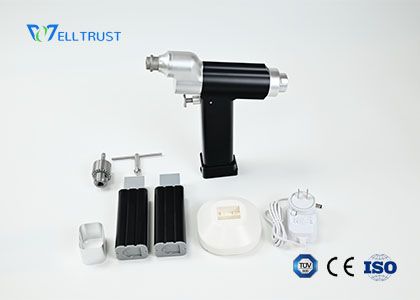
A veterinary cannulated drill is designed for orthopedic procedures that may require a hollow handpiece or cannulated pathway for guide-wire and related work. Compared with a general-purpose drill, a cannulated drill can provide a more procedure-specific configuration for drilling, reaming and selected fixation tasks. Welltrust Vet's AD140 Veterinary Micro Cannulated Drill combines a hollow handpiece design with interchangeable accessories for professional veterinary orthopedic applications.
This guide explains the main features of a veterinary cannulated drill, how to review speed and torque, which accessories may be required, and what hospitals and distributors should confirm before ordering.
A cannulated drill has a hollow or internally guided design that can be used with compatible guide wires, K-wires or attachments, depending on the product configuration. The design is intended to help the surgical team maintain a controlled drilling pathway in selected orthopedic procedures.
The AD140 is described as a veterinary micro cannulated drill with a hollow handpiece and external wire-extension design. The product information lists applications involving cannulated drilling, solid-core osteotomy and micro-screw fixation. Final use depends on the animal, bone size, procedure, compatible accessories and the veterinary surgeon's technique.
The hollow handpiece is the central feature of the AD140 configuration. It is intended to support cannulated drilling work while the external wire-extension design provides a compatible pathway for selected procedures. When purchasing, confirm the required wire size, attachment interface and compatible drill accessories.
The product page describes a lightweight design with a listed weight of approximately 400–500 g. The system is presented for small, medium and large animal surgery. Actual suitability should be assessed according to the procedure, operating position, animal size and the operator's requirements.
The AD140 product information lists no-load speed options of 0–900, 0–1200 and 0–1500 rpm, with peak torque in the range of 2.0–3.0 Nm. Different speed and torque combinations may be selected according to the configuration and procedure. The operating team should follow the applicable technical information rather than selecting a setting based only on the maximum value.
The AD140 is described as autoclavable, and the listed sterilization temperature is 135°C. Cleaning, packaging, sterilization-cycle parameters and inspection should follow the product instructions and the veterinary facility's validated protocol.
The AD140 can be configured with several listed accessories. The accessory choice should be based on the surgical task and confirmed with the handpiece interface before ordering.
| Accessory | Potential role in the configuration | What to confirm |
|---|---|---|
| Jacobs key chuck | Supports compatible drill-bit applications | Chuck size, bit range and interface |
| K-wire attachment | Supports selected wire-guided procedures | Wire diameter and attachment compatibility |
| Flexible reamer | Supports selected reaming requirements | STR interface and procedure requirements |
| Mini acetabular reamer | Supports selected acetabular preparation tasks | Reamer size and compatible connection |
A cannulated drill and a multifunction drill serve different procurement needs. The AD140 is centered on a hollow handpiece and cannulated workflow, while a multifunction model such as the A+100 Multifunction Orthopedic Drill and Saw combines drilling, cutting, reaming and other attachment options in one system.
For a hospital that mainly needs wire-guided drilling and micro-fixation, a dedicated veterinary cannulated drill may be easier to specify. For a service that needs several drilling and sawing functions in one handpiece, a multifunction system may be more suitable. The decision should be based on the case mix, attachment requirements and compatibility with the existing instrument inventory.
Welltrust Vet also supplies the B-D140 Veterinary Cannulated Drill for small-bone and fracture surgery, as well as the TTA Cage for selected canine orthopedic procedures. These products should be evaluated separately according to the procedure and system compatibility.
When requesting a quotation, provide the intended animal size, procedure, required cannulation, attachment type, battery configuration, sterilization requirements and any compatible implant or instrument system. Clear technical information helps distributors and veterinary hospitals compare the correct configuration.
A veterinary cannulated drill is a surgical drill with a hollow handpiece or cannulated pathway that can support guide-wire or K-wire related procedures, depending on the compatible attachment and surgical technique.
The AD140 is designed for veterinary orthopedic applications involving cannulated drilling, solid-core osteotomy and micro-screw fixation, with use selected by the veterinary professional.
The AD140 product information lists no-load speed options of 0–900, 0–1200 and 0–1500 rpm, with speed and torque selected according to the configuration.
Listed accessories include a Jacobs key chuck, flexible reamer, mini acetabular reamer and K-wire attachment. Compatibility should be confirmed before ordering.
The product information describes the AD140 as autoclavable and lists a sterilization temperature of 135°C. The applicable instructions and facility protocol must be followed.
A veterinary cannulated drill should be selected as part of a complete orthopedic workflow rather than as an isolated handpiece. The AD140 combines a hollow handpiece, adjustable speed options, compatible accessories and an autoclavable design for selected veterinary procedures. By confirming the animal size, guide-wire requirements, torque, attachments, sterilization and service support, veterinary hospitals and distributors can create a clearer purchasing specification.
Product information note: This article is provided for product education and purchasing reference. It does not replace veterinary surgical training, clinical judgment, the applicable instructions for use or the regulatory requirements of the relevant market.
Well Trust(Tianjin) Tech. Co.,Ltd,Established in 2005,is the professional veterinary medical devices supplier and exporter. Our main products include: surgical power tools, veterinary orthopedic implants, general surgical instrument, external fixator, sports medicine and other surgery equipment for Veterinary surgery...[ read more ]

