
ivali@welltrusttech.com
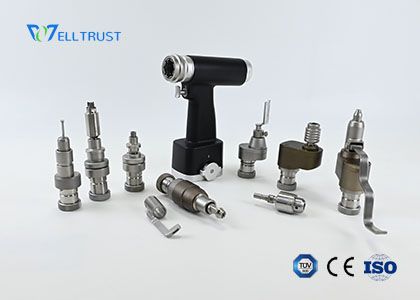
Veterinary orthopedic procedures can require different types of drilling, cutting, reaming, K-wire placement or osteotomy work. A system that supports the required attachments can help a surgical team prepare one coordinated workflow instead of relying on several unrelated handpieces. At the same time, a compact single-function drill may be a better fit for a focused procedure or a practice that needs a lightweight instrument for small-animal work.
For distributors and veterinary hospitals, the evaluation should include both clinical workflow and procurement details: the configuration supplied, available accessories, battery and charger specifications, sterilization instructions, replacement parts and technical support.
A multifunction system is designed around a handpiece or motor that can be used with more than one attachment. Depending on the configuration, the system may support bone drilling, K-wire insertion, reaming, oscillating sawing or other procedure-specific tasks.
The A+100 Multifunction Orthopedic Drill and Saw combines a 14.4V motor system with a 100–250V input range and a 1,800mAh Ni-MH battery. Its configuration includes more than ten attachment types, including Jacobs, small AO quick coupling, cannulated and reaming drill chucks, K-wire insertion, oscillating saw, TPLO saw, craniotomy drilling, cranial milling, reciprocating saw and sternum saw attachments.
When reviewing a multifunction system, confirm which attachments are included in the standard kit and which are optional. This distinction is important for quotations, distributor packages and hospital purchasing decisions.
A dedicated or compact drill can be useful when the main requirement is controlled drilling, K-wire work or small-bone procedures. Weight, grip, battery capacity, cooling and speed control become especially important when the instrument will be used for fine work or during longer procedures.
The EB100 Veterinary Orthopedic Drill uses a Swiss-imported brushless motor and a lightweight modular design. The listed system weight is under 1.3kg, with a 7.4V rechargeable lithium-ion battery rated at 3,000mAh and a charger compatible with 100–250V input. Its modular options include a Jacobs chuck, an AO quick coupling attachment, an oscillating saw attachment and a K-wire attachment.
For a smaller surgical micro drill, the B140 Surgical Micro Drill provides a 0–1,200rpm no-load speed range, a 2.9Nm peak torque and a 1,400mAh battery. Its hollow motor and approximately 500g body are designed for a more compact veterinary orthopedic workflow.
| Selection factor | What to confirm |
|---|---|
| Procedure coverage | Whether the system supports drilling, K-wire placement, reaming, oscillating sawing, TPLO work or other confirmed requirements. |
| Attachment configuration | Which chucks and attachments are included, which are optional and which accessories are compatible. |
| Speed and control | Speed range, variable-speed control, torque and the level of control required for the intended work. |
| Power and battery | Battery chemistry, capacity, operating voltage, charger input and whether a second battery is available. |
| Weight and handling | Handpiece weight, grip design and suitability for the intended animal size and procedure duration. |
| Sterilization workflow | Applicable high-temperature and high-pressure sterilization instructions and any limits for batteries or attachments. |
| Supply and support | Replacement accessories, technical documents, packaging configuration and communication support for distributors. |
A veterinary saw should be evaluated according to the intended procedure, blade compatibility, speed control, battery duration and the range of available blade sizes. The T150 TPLO Saw is designed for canine TPLO work and supports multiple blade specifications. Its listed configuration uses a 12V system, a 1,800mAh battery and a 0–16,000 cycles-per-minute speed range.
For teams comparing a TPLO saw with a multifunction system, the main question is whether the practice needs a dedicated TPLO workflow or a broader system that can support several types of orthopedic attachments. Blade compatibility and the exact supplied configuration should be confirmed before purchase.
Start with the procedures, bone size range, required attachments, battery and voltage requirements, sterilization workflow and service documentation. Then match the configuration to the surgical team's actual workflow.
A multifunction system can accept different attachments for drilling, sawing, reaming or K-wire work. A single-function drill is more focused on drilling and may be preferred when a dedicated, compact workflow is required.
Confirm the motor type, speed range, battery capacity, charger input, attachment configuration, compatible accessories, sterilization instructions, replacement parts and supplier documentation.
Looking for a veterinary orthopedic drill and saw configuration?
Explore the A+100 Multifunction Orthopedic Drill and Saw, EB100 Veterinary Orthopedic Drill and T150 TPLO Saw, then contact Well Trust to confirm the required attachments and configuration.
Well Trust(Tianjin) Tech. Co.,Ltd,Established in 2005,is the professional veterinary medical devices supplier and exporter. Our main products include: surgical power tools, veterinary orthopedic implants, general surgical instrument, external fixator, sports medicine and other surgery equipment for Veterinary surgery...[ read more ]

