
ivali@welltrusttech.com
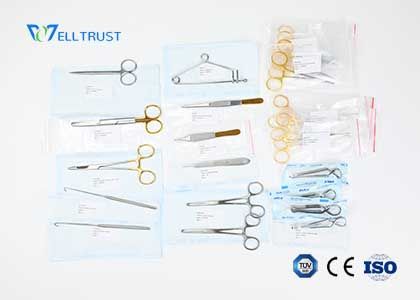
A veterinary spay pack is a coordinated set of surgical instruments prepared for routine ovariohysterectomy procedures in companion animals. The set should support exposure, tissue handling, vessel control, ligation and incision management without requiring the team to assemble every basic instrument separately.
The final configuration depends on the veterinary facility, animal size, procedure protocol and instrument preferences. A pack should therefore be evaluated as a complete workflow rather than by the number of instruments alone.
| Instrument | Typical role in the pack | Configuration example |
|---|---|---|
| Mayo safety pin | General handling and securing tasks during preparation. | 1 piece |
| Mayo dressing blunt | Blunt tissue and dressing handling. | 150 mm, 1 piece |
| Curved dressing blunt | Access and controlled handling in the operative field. | 160 mm, 1 piece |
| Curved Crile artery forceps | Hemostasis and vessel control. | 140 mm, 2 pieces |
| Straight Crile artery forceps | Clamping and tissue or vessel handling. | 125 mm and 160 mm options |
| Curved Halsted mosquito forceps | Fine hemostasis and small-vessel handling. | 125 mm, 2 pieces |
| Backhaus towel forceps | Securing drapes around the surgical field. | 90 mm, 4 pieces |
| Allis tissue forceps | Firm tissue grasping when appropriate to the procedure. | 140 mm, 2 pieces |
| Dissecting forceps | Controlled tissue handling and dissection support. | 1 piece |
| Needle holder with cutter | Needle handling and suture cutting. | 160 mm, 1 piece |
| Adson dissecting forceps | Fine tissue handling. | 1 piece |
| Scalpel handles | Blade mounting for incision work. | #3/#4, 1 piece |
| Canine Snook hook | Uterine or reproductive-tract handling during the planned procedure. | 2 pieces |
| Sterilization box | Storage, organization and sterilization support. | 1 piece |
A clear instrument list helps the clinic confirm whether the pack contains the correct forceps, needle holder, scalpel handles and hooks. Working length and quantity also matter because the same instrument category may be used in different configurations for different surgical workflows.
The WELLTRUST veterinary spay kit uses 316L medical stainless steel for corrosion resistance and hardness, with titanium alloy included for lightweight components where specified. A polished, non-reflective finish can support easier visual inspection and reduce glare in the operating field.
Reusable instruments should be compatible with the facility's validated high-temperature and high-pressure sterilization process. Hinged instruments need inspection, cleaning and suitable lubrication after processing. Before use, staff should check for burrs, misalignment, damage or other signs that could affect handling.
A sterilization box or organized tray can make instrument identification and preparation more efficient. For distributors, product labels should clearly match the instrument names, specifications and quantities in the quotation or packing list.
A basic pack may include tissue and dressing forceps, artery forceps, towel forceps, dissecting forceps, a needle holder with cutter, scalpel handles and a canine Snook hook. The exact configuration should match the surgical team's requirements.
Review the instrument names, working sizes, quantity, material, finish, sterilization compatibility, packaging and storage solution before ordering.
Reusable instruments should be inspected, cleaned, lubricated and sterilized according to the manufacturer's instructions and the veterinary facility's validated workflow. Single-use items should follow their labeling and disposal requirements.
Looking for a veterinary spay pack instrument set?
Explore the WELLTRUST Veterinary Spay Kit Instrument Set for a coordinated instrument configuration, then contact WELLTRUST to confirm the required specifications and packaging.
Well Trust(Tianjin) Tech. Co.,Ltd,Established in 2005,is the professional veterinary medical devices supplier and exporter. Our main products include: surgical power tools, veterinary orthopedic implants, general surgical instrument, external fixator, sports medicine and other surgery equipment for Veterinary surgery...[ read more ]

